The moral and intellectual sterility of fashionable society
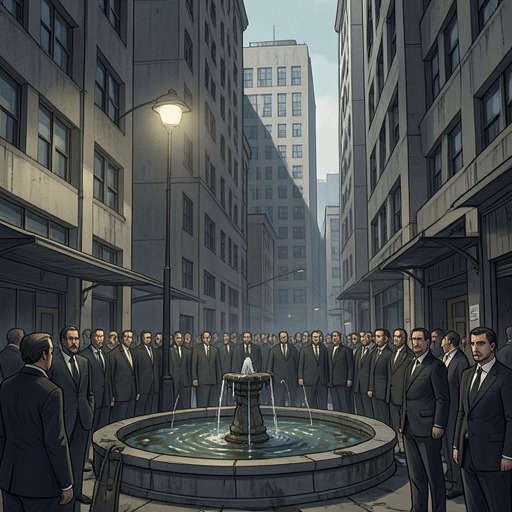
Eugene OneginThe moral and intellectual sterility of fashionable society is a condition Eugene Oneguine exposes through its repeated images of empty conversation, cold social judgment, and life reduced to imitation. Its members move through the forms of sociability without the thought or passion those forms promise: the drawing room offers gossip in place of exchange, while the larger fashionable world joins urbanity to harshness and turns existence into a show. The result is not simply dull company, but a social order in which feeling and independent thought have little room to act.
The fashionable world as a social environment
The poem locates this sterility in the everyday operation of fashionable life. Its world contains sly and pusillanimous figures, spoiled children, ridiculous rogues, and fervent censors; the catalogue refuses to present fashionable society as a single vice or a single type. Rather, its moral failure ranges from cowardice and indulgence to ridicule and zeal for censorship. These figures coexist in the haunts of fashion, where politeness does not prevent betrayal. Urbanity is the outward manner; harshness is what that manner carries.
The social atmosphere is marked by sentences that are cold and unfeeling. Judgment does not disappear in this world; it becomes more pervasive and less humane. Society continues to evaluate and pronounce, but the language of its judgments has lost warmth. This contrast between polished conduct and emotional coldness is central to the poem’s indictment: civilized appearance does not amount to moral or intellectual life.
Conversation without thought or feeling
The drawing room gives the condition its most intimate form. Tattiana would gladly hear the conversation of polite society, but those around her take delight in gossip. Their speech is tame and colourless, and even its slander has become wearying. Gossip persists as a social activity, yet repetition has drained it of excitement and consequence. The room is full of talk but offers no substantial exchange.
The poem sharpens the criticism by describing this chatter as sterile. Questions, news, and tittle-tattle circulate, but sense is never present—not even by mistake or without intention. Wit cannot rescue the conversation: the languid mind cannot smile at anything, and a joke cannot make the heart beat. The absence is therefore both intellectual and emotional. The company does not merely lack serious discussion; it has lost the capacity to be surprised, amused, or moved.
Tattiana’s wish to hear the world’s polite conversation sets her receptiveness against the drawing room’s exhausted routine. She is present among its speakers, but their pleasures do not satisfy the interest she brings to them. The contrast does not require her to deliver an explicit denunciation: the mismatch between her desire to listen and the social group’s reliance on gossip makes the poverty of its conversation visible.
Performance, repetition, and wasted youth
The poem widens the drawing-room scene into a picture of fashionable existence as spectacle. Life is contemplated as a show, and the crowd is imitated eternally. Participation becomes performance: people reproduce the crowd’s outward conduct while taking no part in its passions or modes of thought. In this account, conformity is not active fellowship. The individual remains detached from the very feelings and ideas that might make collective life meaningful, yet continues to copy its accepted forms.
The image of fallen, withered leaves gives this condition a temporal cost. Looking back, the speaker reflects sadly that youth was received in vain and betrayed repeatedly; the leaves of former hopes or possibilities have withered and lie scattered like those of autumn. What follows seems to be no opening into a fuller life but the prospect of an endless row of dinners. That prospect makes social repetition concrete: the future stretches ahead as one more scheduled occasion after another, while life is watched from a distance as a spectacle.
The contrast is between youth as a possibility and a life spent rehearsing the seemly crowd. The poem does not portray imitation as an isolated lapse; its perpetuity is the point. When each day reproduces the same social forms, the person may remain outwardly active yet be excluded from passion and thought. The fear of a long succession of dinners thus condenses a broader anxiety about time passing without genuine participation.
The poem’s social critique
The preface frames the poem’s Russian-life scenes as faithful pictures of manners whose characteristics have endured across decades. Against that background, the satire of fashionable society functions as social observation as well as moral judgment. Its details are not confined to an abstract complaint about bad company: the drawing room, gossip, formal politeness, public judgments, and recurring dinners show how emptiness is enacted in ordinary social practices.
The speaker includes himself and his readers in the diagnosis, describing the fashionable world as a morass in which both writer and companions wallow. This admission complicates the stance of satire. The poem does not set an entirely innocent observer outside the criticized society; its first-person plural makes the speaker part of the compromised world he describes. The criticism therefore carries self-implication alongside mockery, and the image of the morass suggests that fashionable emptiness is an environment people inhabit rather than a defect easily escaped.
Across these scenes, sterility links manners, language, and the experience of time. Politeness can conceal betrayal, conversation can persist without sense, humor can fail to reach the heart, and social life can proceed as an endless performance. By moving from the drawing room’s exhausted gossip to the imagined row of future dinners, the poem shows how a public world deprived of thought and feeling can turn both companionship and youth into forms of repetition.